
The Gods We Make
Growing up without faith and finding something else to believe in

Excerpt #8 from my memoir, Your Dad Is a Dog, a work about exile, inheritance, and self-reinvention. These serialized fragments offer glimpses of the larger, rights-exclusive manuscript, intended for future print and digital publication. Follow me here on Substack for future installments—each stands alone, yet together they trace one story of metamorphosis.
I’m an atheist by disposition. I can’t claim that conviction still holds its original ground, but for as long as I can remember, I lumped the idea of God with Santa Claus and good Christian rock: things people believe in with all their hearts, but that do not exist. The idea that the future was determined by a belief system and not the result of a series of random, chaotic events was a strange concept. The truth, at least in this regard, was abundantly clear to me from a young age: people see the same things differently.
My lack of blind faith didn’t mean that I was unfamiliar with it. Madarjoon stuck to her five daily prayers, and the white kids I knew all had a relationship with church: some were willing believers, some attended by parental mandate, and some just dabbled in Jesus. I couldn’t be fooled. Whether it was Muslims whispering in the direction of Mecca, Jews swaying and mumbling at a wall, or Christians kneeling and mumbling into folded hands, beneath all that showy devotion was a prayer to God that he was real. All that praying moved nothing but the air around it.
Most of the time, my parents avoided discussing religion. Sometimes, when Dad was drunk, he’d openly question Allah’s existence, but otherwise, he evaded the topic. Mom, who might’ve had the personality of someone susceptible to the allure of a cult, found organized religion too confining. As a result, I was raised never to waste bandwidth on large, structured magical thinking, only to later disabuse myself of it, like so many others. In my eyes, eternal reward or eternal damnation predicated on one’s actions in this life was a compelling form of mind control.
I’ll confess here to one solitary incident when I deigned to clasp my hands together and pray for the intervention of some imagined omniscient, omnipotent, omnipresent force. I begged for the intervention of a desperate friend’s life, a friend I’d never met. For one night, I believed I possessed the same magical powers that most of the world believed it had always possessed. My foray into faith unravels later.
Godlessness didn’t preclude a fascination with the paranormal, having been weaned on horror movies and books steeped in religiosity and religious scrutiny. My bedroom bookshelf propped every book published by the King of Horror, including his Richard Bachman collection and various anthologies containing his early short stories. Demons, ghosts, aliens, they were all more real in my mind than Allah. This was harmless magical thinking, the kind that didn’t result in gunning down worshippers in a synagogue or flying planes into buildings.
I found divinity in the form of fictionalized horror and the guise of fast, angry songs about death, sex, and excessive drug use. Had it not been for that chance meeting on my first day of ski school, my taste in music might have gone in a completely different direction. I might have willingly attended my very first live concert with Mom and Mehran at the Key Arena, seeing Genesis. “You can bring a friend!” Mehran said before Mom told me that I didn’t have to go if I didn’t want to. Rush, Yes, Jethro Tull, I found progressive rock and its lyrical designs that leaned heavily on mysticism and fantasy stupid. I had spent hours listening to Mehran complain that Genesis was better when Peter Gabriel was in it. Wouldn’t I want to hear him roar that same supercilious garbage over an encore of “Domino”? Mehran wore his “We Can’t Dance Tour” t-shirt out all the time.
Hard rock was melody and raw energy, the fulminating backdrop of my entire existence. It insulated me from the emotionally unstable people in my life. Locked in my room, I’d go on autopilot rocking out—head banging, foot stomping, mattress punching; the music provided an instantaneous change of consciousness, an altered state that allowed me to reveal a different form of myself. It was metaphysical solace. It brought something to life in me, something powerful, something healing that inspired a form of creative expression. I thought about the songwriters who reached inside me and pulled out this potency.
MTV was an unreliable source for what I needed. You had to sit through a hodgepodge of shit—hours of bubblegum pop and insipid R&B to catch the epic video for Metallica’s “One,” or something worthwhile like that. Mercifully, there was a local program in Seattle called Bombshelter Videos shown during the wee hours of Saturday nights, or Sunday mornings, take your pick.
At Mom’s, the living room transformed into our makeshift bedroom each night, the glow of the TV our lullaby. Saturday nights were sacred, governed by a strict viewing itinerary: Monstervision on TNT was first on the viewing roster, hosted by the sly, bolo tie-wearing Joe Bob Briggs (now he could pull off a bolo tie). Next, the darkly comic Tales from the Crypt on HBO. Then some local flavor: Almost Live—a local sketch comedy program—and then Saturday Night Live. Finally, the farcical suspense of Tales from the Darkside, a gem we discovered on some obscure Canadian channel. After all that, it was Bombshelter Videos. Bombshelter was on a public access channel. Kevin was usually asleep by the time it aired.
The opening to Bombshelter Videos was a mash-up of random images of destruction over heavy metal music and someone yelling, “Bombshelter! Bombshelter! Bombshelter! Bombshelter!” in the most aggressive, head-bangingest way imaginable. The host was a dude named Bill Bored—wink, wink—who wore long, black skater shorts and a t-shirt of an underground garage band, like Cat Butt or Circle Jerks or Angry Samoans.
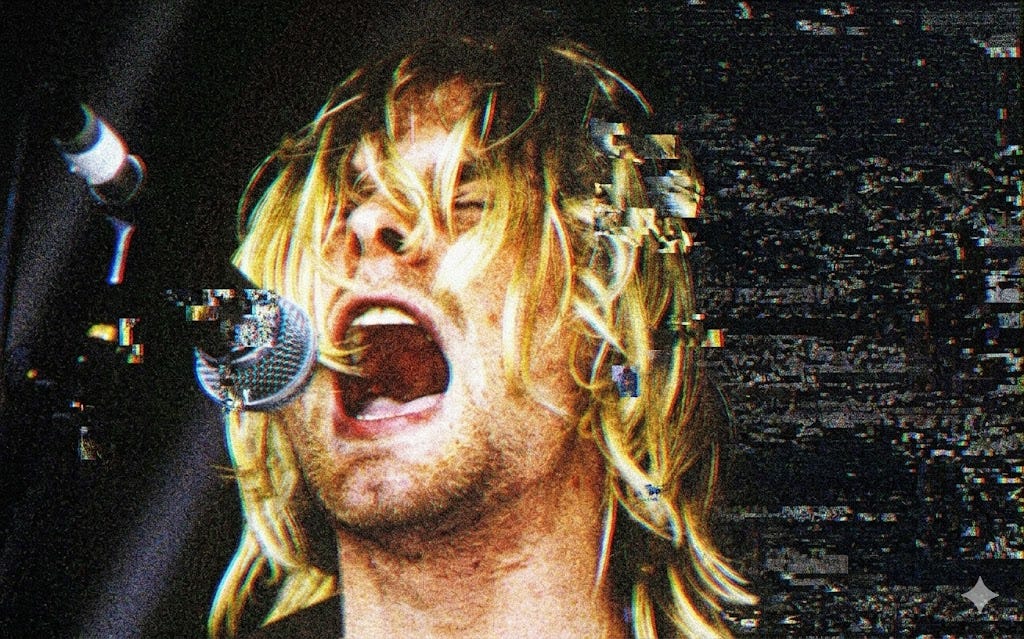
Bombshelter Videos gave every iteration of rock music a try. It was thirty minutes of death, thrash, punk, new wave, and satanic speed metal with dudes dressed in drag, cheap-looking music videos, and grainy live performances you’d never see on mainstream TV. The program showcased the local scene, bands from our little insular outpost in the Northwest, bands later tagged “grunge,” a throwaway label of dubious origin. These were bands like Tad, The U-Men, Green River, Mother Love Bone, Mudhoney, and Soundgarden; bands on the SST and Sub Pop record labels. And Nirvana, back when Kurt had long stringy blond hair to the middle of his back, and the band traveled by van instead of a corporate jet. I saw Nirvana on Bombshelter, and they made no more of an impact on me than, say, L7 or Pixies. It was good. It was hard. The lyrics were dark and full of destruction. I fucking loved it.
Hard rock captured the raw energy of rage and chaos I felt, channeling it into sound rather than letting it manifest as impotent self-loathing. Hard rock was the nascent fury churning within me, the darker urges and dynamism and senselessness I was too afraid to express outwardly in any constructive way. Hard rock was humankind’s brilliant foray into shaping internal chaos. (Isn’t all great art the expression of ordered chaos?)
There was something unique to the local scene. These bands had lead singers who explored ideas of self-doubt, self-discovery, interconnectedness, and isolation in a disarmingly earnest way. They were voices of progress and inclusivity. They were more than just singers; they were educators. Their dark, gloomy lyrics were little nuggets of genuine emotion, provocative and deeply resonant.
My interest in the local music scene struck just as I was once more agitating for a transformed life, and once more, through an external representation of my internal self. I was no longer a little kid obsessed with a supernatural messiah in blue tights or physical anomalies yoked up and firing machine guns that never seemed to run out of ammunition. This was real life now. But what becomes of you when you’ve chewed up your idols and spat them out? You leap headlong into the jaws of another invented god, naturally—one struggling with the very same identity crisis as you.
Despite the abundance of genuine underground talent, garbage still found its way into my life. I remember being very excited about getting my hands on Vanilla Ice’s debut album, featuring the ever-present rip-off single, “Ice Ice Baby.” Many nights, I fell asleep listening to that musical abortion on my Walkman. Fortunately, that album, and perhaps a few more aberrations not worth mentioning, were short-lived curiosities.
“Smells Like Teen Spirit” was the sonic grenade that detonated any lingering susceptibility to the musical landfill of artists like Vanilla Ice. The first time those opening chords ripped through the air—now instantly recognizable by everyone on the planet—I was perched on Dad’s bed, watching MTV. Sometimes when Dad was downstairs enduring the weekly grumblings of everyone’s favorite curmudgeon on 60 Minutes, Kevin and I would move upstairs, hop on his bed, and watch what we wanted, usually the subversive brilliance of The Simpsons.
I remember growing nice and tall, more alert as “Smells Like Teen Spirit” progressed, like the way I sat up when Madarjoon carried a pot of ghormesabzi to the table. I heard in the music echoes of my pain and troubles, the entire tenor of my world. Not to mention, you could dance to it. But what was that skinny, bedraggled kid hiding behind a mop of stringy blond hair mumbling about?
At the end of the video, the album title came up: Nevermind. Brilliant. Trash bands like Winger, Warrant, Mr. Big, and Extreme (a band Nirvana would open for) were inescapable, a zombie horde coming through my television set to eat the part of my brain housing good taste. Nirvana gave a much-needed injection of sincerity into popular music. Of course, that came with a huge price for all involved and American culture as a whole. Corporate America would cannibalize the sound and construct monsters of grotesque imitation, and later transform Nirvana into a yuppie trend. And the worst was still to come.
This is the eighth excerpt from my memoir, Your Dad Is a Dog. Selected excerpts can be found below:


There’s a raw honesty here in how belief is dismantled and then quietly rebuilt in other forms. The way music becomes both refuge and identity is especially sharp it doesn’t just reflect the internal state, it organizes it.
I needed to read this today, Kian. I feel like I am having a spiritual crisis right now (I am grieving), and your piece brought some light in. Thank you.